
Everyone knows that money woes can lead to stress and anxiety. But what you may not know is that financial wellness and mental health are actually connected and can really impact our overall health. In fact, having a healthy relationship with money is an important part of maintaining your mental wellbeing. So if you’re feeling overwhelmed by financial stress, it’s important to take steps to improve your financial wellness. And in turn, this can help keep your mental and physical health in check. In this post, we’ll explore how financial wellness affects mental health and vice versa, and what you can do to improve your overall well-being.
Statistics on Impacts of Financial Wellness on Overall Health
The APA surveyed adults in February 2022 and found that the number of adults who said that money was a source of stress had increased significantly from similar surveys done in June and February 2021. The number of adults who said that money was a source of stress went up from 61% to 65% between June 2021 and February 2022. Similarly, the number of adults who said that the economy was a significant source of stress had increased significantly from the surveys done in August and June. The number of adults who said the economy was a source of stress went up from 57% to 65%. Half of all U.S. adults also said that housing costs were a significant stressor, which is up from February 2021.
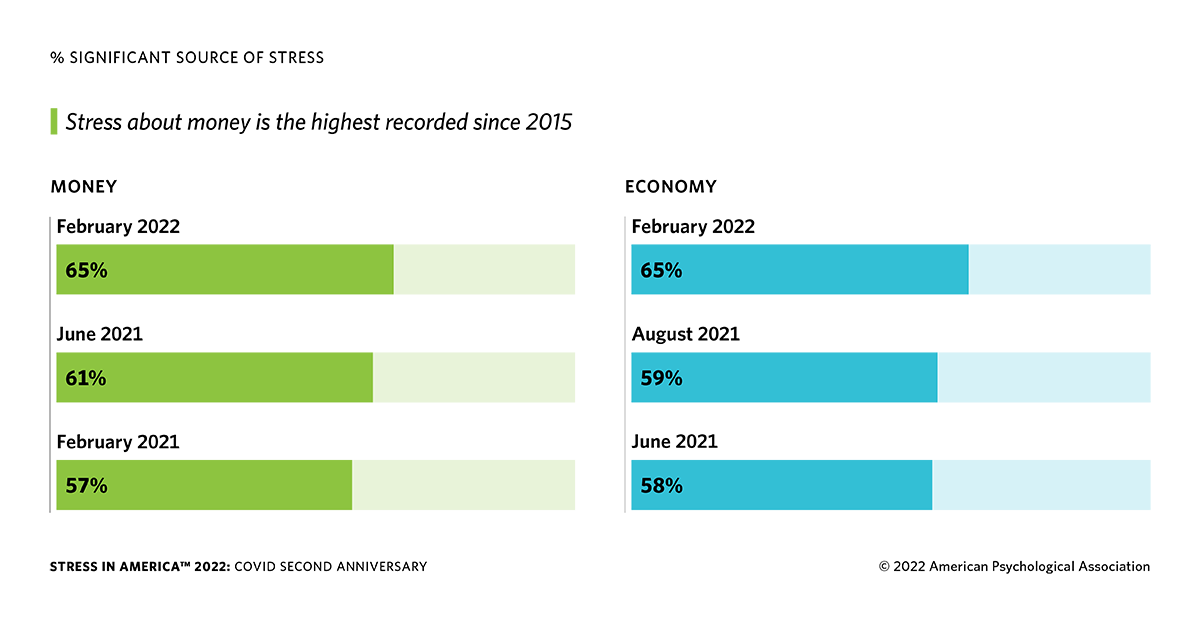
The surveys found that similar trends are seen spanning most age groups with those aged 18 to 43 being more likely than those aged 44 or older to report that money caused them a significant amount of stress.
How Does Financial Wellness Affect Mental Health?
It’s no secret that financial stress can take a toll on our mental health. When we’re worrying about money, it’s hard to focus on anything else. We may lie awake at night worrying about bills, or spend our days stressing about how we’re going to make ends meet. This constant state of worry about our financial challenges can lead to anxiety, depression, and a whole host of other mental health problems. It’s not just our mental health that suffers when we’re under financial stress. Our physical health can also be affected. Studies have shown that financial stress is linked to high blood pressure, heart disease, and even premature death. This is why it’s so important to practice financial wellness. When we’re financially well, we’re better able to manage our money and reduce our stress levels. As a result, we’re happier, healthier, and more productive. So what are some ways to achieve financial wellness?

How Can Financial Literacy Help Improve Mental Health?
Having good financial habits gives people a sense of control over their lives, which is an important part of maintaining mental health. When people feel like they’re in control of their finances, they’re less likely to experience anxiety and depression. Financial literacy can also help people make better decisions about their money. This is because when people are more knowledgeable about personal finance, they’re less likely to make impulsive decisions that can lead to debt or financial stress.
Making small changes in your financial habits can have a big impact on your mental health and financial wellness. If you’re not sure where to start, there are plenty of resources available to help you improve your financial literacy. You can start by reading books or articles about personal finance, taking a financial planning course, or meeting with a financial advisor.
No matter what steps you take to improve your financial literacy, remember that even small changes can make a big difference in your mental health. Often times financial concerns and mental health issues form a vicious cycle that just needs to be broken. So don’t be afraid to start making some changes in your financial habits today.
6 Ways to Improve Financial Wellness
There are plenty of things you can do to improve your financial wellness and start feeling more confident about your money situation. Here are six tips to help get you started towards a healthy financial future.
1. Live below your means
One of the best ways to improve your financial wellness is to live below your means. This means spending less money than you make and saving the rest. When you live below your means, you’re less likely to experience financial stress because you’re not trying to keep up with a lifestyle that’s beyond your budget.

2. Have an emergency fund
it’s important to save for emergencies. This way, if unexpected expenses come up, you’ll have the money to cover it without going into debt. Having an emergency fund can also help reduce your financial stress level because you’ll know that you have a safety net in case of tough times. Having a form of financial security blanket can also help prevent you from further falling into debt in case of unforeseen events.
3. Invest for the long term
Investing for the long term is one of the best ways to improve your financial wellbeing. When you invest, you’re putting your money into something that has the potential to grow over time. This can help you build wealth and reach your financial goals.
4. Diversify your investments
When it comes to financial wellness, there are many things you can do to improve your overall picture. One of the most important things you can do is to diversify your investments. Diversifying your investments means spreading your money around into different areas, so that if one investment fails, you have others that can help offset the loss.
5. Stay disciplined with your spending
By carefully tracking your spending and making sure that you are not overspending on unnecessary items, you can make a big impact on your overall financial health. Of course, this is easier said than done. It can be difficult to stay disciplined with your spending, especially when there are so many tempting purchases out there. However, if you can commit to being more mindful about your spending, you will find that it pays off in the long run. Here are a few tips to help you stay disciplined with your spending:

- Track your spending. One of the best ways to stay disciplined with your spending is to track it carefully. There are a number of different ways to do this, including using a budgeting app or simply writing out your expenses in a journal. By tracking your spending, you will be able to see where your money is going and identify any areas where you may be overspending.
- Make a budget. Once you know where your money is going, you can start to create a budget. This will help you to allocate your funds in a more deliberate way and ensure that you are not overspending in any one area.
- Set spending limits. Another way to stay disciplined with your spending is to set limits for yourself. For example, you may want to limit yourself to only spending $50 per week on non-essential items. This can be a helpful way to keep your spending in check and make sure that you are not over indulging.
- Avoid impulse purchases. It can be tempting to make impulse purchases, especially when something is on sale or you see a great deal. However, these types of purchases can quickly add up and put a dent in your budget. If you can learn to resist the urge to impulse buy, you will be much better off financially.
- Pay cash. One simple way to stay disciplined with your spending is to pay cash for your purchases instead of using credit cards. When you use cash, you are more likely to be mindful of your spending because you can physically see the money leaving your hands. This can help you to avoid overspending and stay within your budget.
If you can commit to being more disciplined with your spending, you will find that it has a major impact on your financial wellness. By tracking your spending, setting limits, and avoiding impulse purchases, you can stay on top of your finances and improve your overall financial health.
6. Avoid debt
It’s no secret that debt can be a major contributor to financial stress. Not only does it add to your monthly expenses, but it can also lead to costly interest charges and late fees. And if you’re struggling to make your payments, debt can even damage your credit score.
That’s why avoiding debt is one of the best things you can do for your financial well being. When you live within your means and refrain from borrowing money, you’ll be in a much better position to save for your future and reach your financial goals.
Of course, there are times when taking on debt may be unavoidable. If you’re looking to buy a home or finance a major purchase, for example, you’ll likely need to secure a loan. But in general, it’s best to avoid borrowing money if you can.
Wrapping it up

When it comes to our mental and physical health, we need to take a holistic view. By improving our financial wellness, we can break the cycle of stress that impacts both our minds and bodies. We hope this article has shown you how interconnected your financial health and overall wellbeing are, and that you will continue on in your journey of financial education.